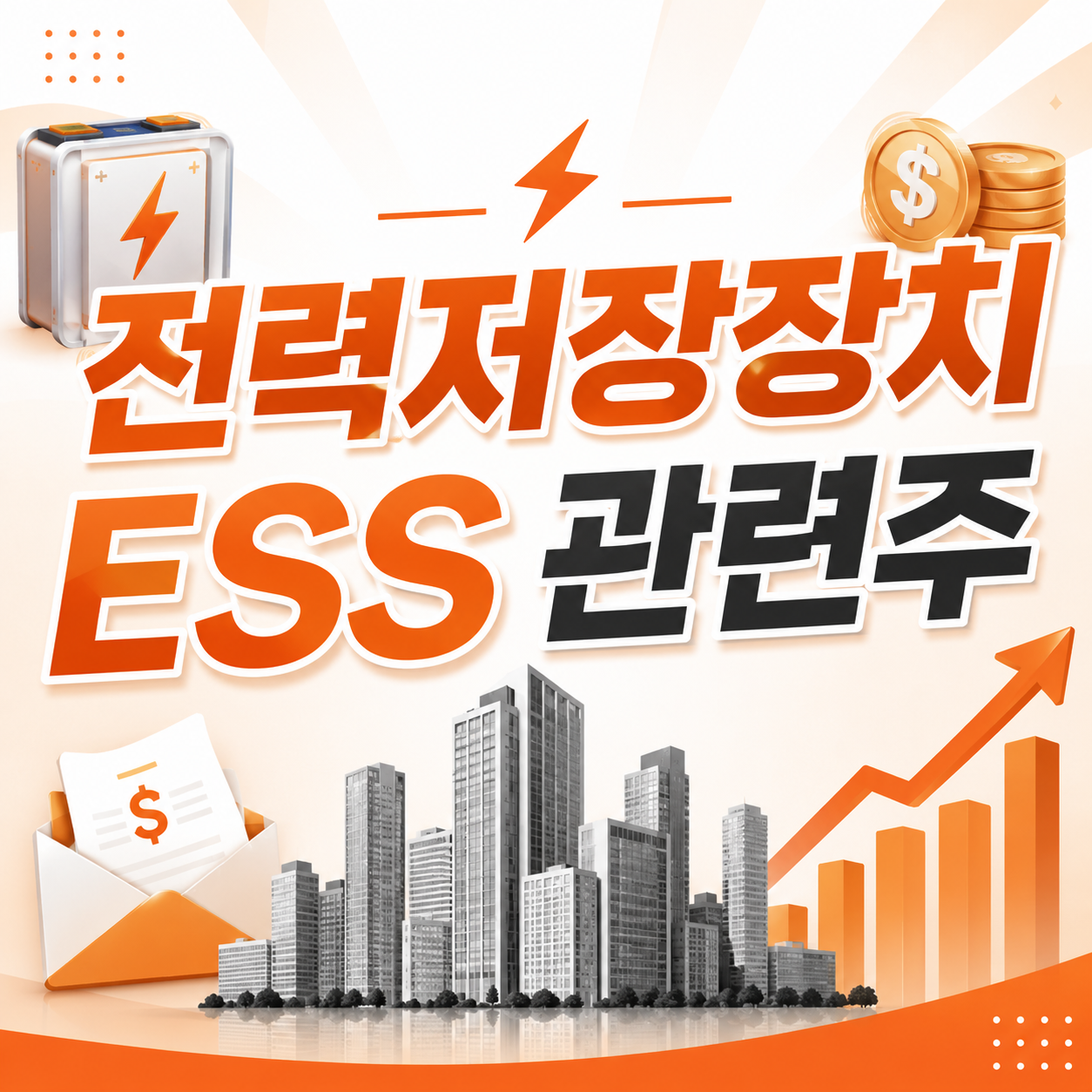
The secondary battery market, which previously focused solely on electric vehicle (EV) batteries, is shifting its focus back to ESS (Energy Storage Systems). This is because the demand for power grids, renewable energy, and AI data centers continues to grow, even as EV demand fluctuates. ESS related stocks should be analyzed beyond just battery cell manufacturers; they encompass power conversion systems (PCS), power equipment, system integration, renewable energy development, and component supply.
Key Summary of ESS Related Stocks
Energy Storage System Theme: From Batteries and PCS to Power Grids and Renewable Energy
ESS stands for Energy Storage System, a device that stores electricity and supplies it when needed. It is a theme linked to stabilizing irregular outputs from sources like solar and wind power, lowering peak power demand, and meeting the stability needs of data centers and power grids.

When looking at ESS related stocks, the first thing to distinguish is their position in the business chain. Battery cell manufacturers, power equipment companies making PCS and EMS, component companies supplying ESS containers and structures, and companies developing renewable energy power plants and ESS projects all fall under the same theme, but their financial performance patterns differ.
The reason why the ESS market is attracting attention is clear. As the share of renewable energy grows, facilities are needed to store electricity when production is high and discharge it when demand is high. Combined with AI data center power demand, power grid delays, the expansion of local production in the U.S., and the transition to LFP batteries, ESS is becoming a separate growth axis within the secondary battery industry.
Basic Structure of ESS
ESS Related Stocks at a Glance
| Category | Stock | Related Point | Points to Check |
|---|---|---|---|
| Battery | LG Energy Solution | LFP batteries for ESS, North American ESS supply contracts, U.S. local production | Whether ESS orders compensate for the EV slowdown |
| Battery | Samsung SDI | Recovery in demand for ESS, UPS, and BBU; expansion of ESS battery sales | Reduction of battery business losses and ESS profitability |
| PCS/System | LS ELECTRIC | ESS platform, PCS, power solutions, data center and DC transition strategy | Overseas ESS orders and co-growth with power equipment performance |
| System Integration | Hyosung Heavy Industries | ESS system supply, maintenance, consulting, PCS/EMS capabilities | Project orders and whether it aligns with the power equipment cycle |
| Components/Equipment | Seojin System | Sales exposure related to ESS equipment, cases, and structures | Resumption of client orders, debt ratio, and profitability fluctuations |
| Development/Operations | SK Eternix | Solar, wind, and ESS portfolio; potential participation in the centralized contract market | Project development speed and expansion of power brokerage/ESS business |
| Solar + ESS | Hanwha Solutions | Qcells’ solar and ESS integration, U.S. power grid ESS projects | Solar market conditions, U.S. project profitability, and module prices |
| Indirect Beneficiary | Power Equipment Companies | Possibility of coinciding with transformer, distribution, and power grid investments as ESS spreads | Distinguish between direct ESS sales and indirect power grid benefits |
Why is the ESS Theme Resurfacing Now?
Mitigating Renewable Energy Curtailment
As solar and wind power increase, the times of high electricity production and actual demand often mismatch. ESS stores surplus electricity to reduce curtailment and increase the stability of the power system.
AI Data Center Power Demand
AI data centers have high power consumption and significant peak loads. ESS can mitigate power peaks and serve as a backup power source during blackouts or power grid constraints, linking it with the data center theme.
Transition to LFP Batteries
ESS has relatively lower energy density requirements than electric vehicles, while stability and price are crucial. This leads to a trend of increasing ESS supply contracts based on LFP batteries.
Offsetting the EV Slowdown
As demand for EV batteries slows down, battery companies look to ESS as a new growth axis. Production line transitions and U.S. local ESS projects become significant news.
Battery ESS Related Stocks
LG Energy Solution is the stock most directly linked to the supply of ESS battery cells and systems. It signed an ESS battery supply contract of approximately 5GWh with Hanwha Qcells’ U.S. subsidiary, structured to supply LFP batteries for ESS produced at its Michigan Holland plant from 2028 to 2030. Although it is an EV battery-focused company, ESS is emerging as a separate growth axis as it links with North American power grids and renewable energy projects.
Samsung SDI’s recovery in demand for major applications such as ESS, UPS, BBU, and power tools was mentioned as a factor in the improvement of its battery business performance in the first quarter of 2026. It is a representative stock that runs both EV and ESS battery businesses, and the recovery of demand for power grids and industrial storage systems is key to the stock’s theme.
SK On is an unlisted company, but it is known to have signed an LFP ESS battery supply contract of up to 7.2GWh with Flatiron Energy in the U.S. and plans to mass-produce LFP batteries dedicated to ESS starting in the second half of 2026. From the perspective of direct purchase of listed companies, the parent company, group governance structure, and the burden of the battery business versus profitability improvement should be considered together.
Power Equipment and System ESS Related Stocks
LS ELECTRIC is a stock directly linked to ESS, PCS, and smart power solutions. In the company’s Q1 2026 materials, it presented DC transition, data center market expansion, and ESS as its global business strategies. Since ESS is not completed with batteries alone but requires power conversion systems and control systems, LS ELECTRIC is a stock where the power equipment cycle and the ESS theme can be viewed together.
Hyosung Heavy Industries officially describes its role in the ESS business as performing system supply, maintenance, and construction consulting. It is closer to a system integration type stock that includes PCS, EMS, batteries, and operations management. Its experience in supplying ESS for various purposes, such as renewable energy linkage, frequency adjustment, peak reduction, and microgrids, is a key point to watch.
As ESS increases, investment in power grid reinforcement, substations, distribution facilities, and power control systems may also increase. However, since not all power equipment companies are direct ESS beneficiaries, it is necessary to distinguish whether they have actual ESS products, orders, or division sales, or if they are indirect power grid beneficiaries.
Components and Renewable Energy Development ESS Related Stocks
Seojin System is a stock with exposure to components and manufacturing, such as ESS equipment, structures, and cases. Its business report mentions that the expansion of orders from ESS and semiconductor equipment clients in 2024 was a factor in its sales increase. However, variables such as deferred orders from ESS clients, tariffs, inventory, and debt burden must also be checked.
SK Eternix is a company based on a renewable energy portfolio including solar, onshore wind, and ESS. It is a stock where the ESS centralized contract market and renewable energy development business can be viewed together; it should be approached from the perspective of ESS project development and operation rather than being a battery manufacturer.
Hanwha Solutions’ Qcells division is linked to the energy solution business that integrates solar and ESS. Hanwha Qcells’ U.S. subsidiary signed an ESS battery supply contract of 5GWh with LG Energy Solution, structured so that the batteries are used in U.S. power grid ESS projects. Solar module market conditions and ESS project profitability should be considered together.
ESS Related Stocks Investment Checkpoints
First, the proportion of ESS sales must be checked.
Even among ESS related stocks, the movement can differ between companies where most of their actual sales come from ESS and those where only a portion of their power equipment or battery business is exposed to ESS.
Second, order volume and delivery timing must be considered together.
Even if an ESS contract is announced in GWh scale, delivery often takes place over 2 to 3 years. It is necessary to distinguish between short-term performance reflection and long-term sales visibility.
Third, LFP and local production in the U.S. are important.
Since price competitiveness is crucial for ESS, the adoption of LFP batteries is increasing. For U.S. projects, local production and fulfillment of policy requirements can impact order competitiveness.
Fourth, safety regulations and fire issues should not be ignored.
As ESS facilities handle large-scale batteries, fire safety, certification, insurance, and follow-up management systems are important. Rather than just looking at order news, safety-related costs should also be considered.
Fifth, power grid policies and the centralized contract market must be checked.
Domestic ESS demand is linked to policies for mitigating renewable energy curtailment and stabilizing the power system. Government bidding volumes and results can directly affect project developers and system companies.
How to View Related Stocks by Role
| Role | Example Companies | News Likely to Impact Stock Prices |
|---|---|---|
| Battery Cell | LG Energy Solution, Samsung SDI | GWh-scale supply contracts, LFP mass production, North American local production, ESS sales growth |
| Power Conversion/Control | LS ELECTRIC, Hyosung Heavy Industries | PCS/EMS orders, data center power solutions, domestic and overseas ESS projects |
| System Integration | Hyosung Heavy Industries, LS ELECTRIC | Renewable energy linked ESS, frequency adjustment, peak reduction, microgrid construction |
| Components/Equipment | Seojin System | Resumption of client orders, ESS equipment supply contracts, production capacity expansion |
| Renewable Energy Development | SK Eternix, Hanwha Solutions | ESS centralized contract market, Solar + ESS projects, expansion of power brokerage and PPAs |
| Indirect Infrastructure | Power Equipment/Transformer Companies | Power grid investment, substation expansion, expansion of data center power infrastructure |
Risks of ESS Related Stocks
The ESS theme has high growth potential but also high volatility.
Falling battery prices, competition with Chinese LFP companies, project delays, rising interest rates, power grid permit delays, fire safety regulations, and deferred client orders can all be risks.
In periods of rapid theme-driven surges, verifying performance is even more important.
Stocks that rise based on the “ESS” keyword alone may have a low proportion of actual sales. Sales, operating profit, order backlog, clients, delivery schedules, and debt ratios must be checked together.
This article is not an investment recommendation.
It is an informative article summarizing the structure of the ESS-related industry and the connection points for each stock. Individual stock buy/sell decisions should be made based on the investor’s own financial situation and risk preference.
Frequently Asked Questions
Q. Which stock is the leader in ESS?
A. It depends on the timing and market sentiment. LG Energy Solution and Samsung SDI are representative for direct battery benefits; LS ELECTRIC and Hyosung Heavy Industries for power conversion/systems; Seojin System for components; and SK Eternix and Hanwha Solutions for renewable energy development.
Q. Are ESS related stocks the same as secondary battery related stocks?
A. They overlap but are not identical. ESS includes not only battery cells but also PCS, EMS, power grids, installation/operation, and renewable energy projects. Therefore, it has a broader scope than secondary battery stocks.
Q. Why is ESS linked to data centers?
A. Data centers consume large amounts of power and need to minimize blackout risks. ESS can be used for peak power mitigation, backup power, and power grid stabilization, linking it with the AI data center theme.
Q. What is the first indicator to check when looking at ESS related stocks?
A. It is best to first check the actual proportion of ESS sales, new order volume, delivery period, clients, operating profit margin, and debt ratio. Not all companies receiving the “ESS” keyword benefit equally.
Q. Where does the domestic demand for ESS come from?
A. Major demand comes from mitigating renewable energy curtailment, stabilizing the power grid, installations in public institutions, industrial peak reduction, data center power stabilization, and centralized contract market bidding.
Conclusion
ESS related stocks have emerged as a new pillar in the secondary battery market, which previously focused only on the electric vehicle battery industry. With the overlap of renewable energy expansion, power grid stabilization, AI data center power demand, and U.S. LFP ESS projects, not only battery companies but also power equipment and system companies are attracting attention.
However, the nature of ESS related stocks varies by company. They should be categorized: LG Energy Solution and Samsung SDI from a battery cell perspective; LS ELECTRIC and Hyosung Heavy Industries from a power conversion and system integration perspective; Seojin System from an equipment and component perspective; and SK Eternix and Hanwha Solutions from a renewable energy project perspective.
Rather than approaching with just the words “the ESS market is growing,” it is important to check actual orders and the timing of performance reflection, the proportion of ESS sales, client and delivery structures, and safety costs and financial burdens. Distinguishing companies whose performance follows the theme is the most important criterion when looking at ESS related stocks.