Detective Conan: Fallen Angel of the Highway

| Item | Details |
|---|---|
| Title | Detective Conan: Fallen Angel of the Highway |
| Key topics | Detective Conan Fallen Angel of the Highway, Detective Conan 2026, Case Closed movie, Chihaya Hagiwara, anime movie, Korean theatrical release |
| Information checked | August 11, 2026 |
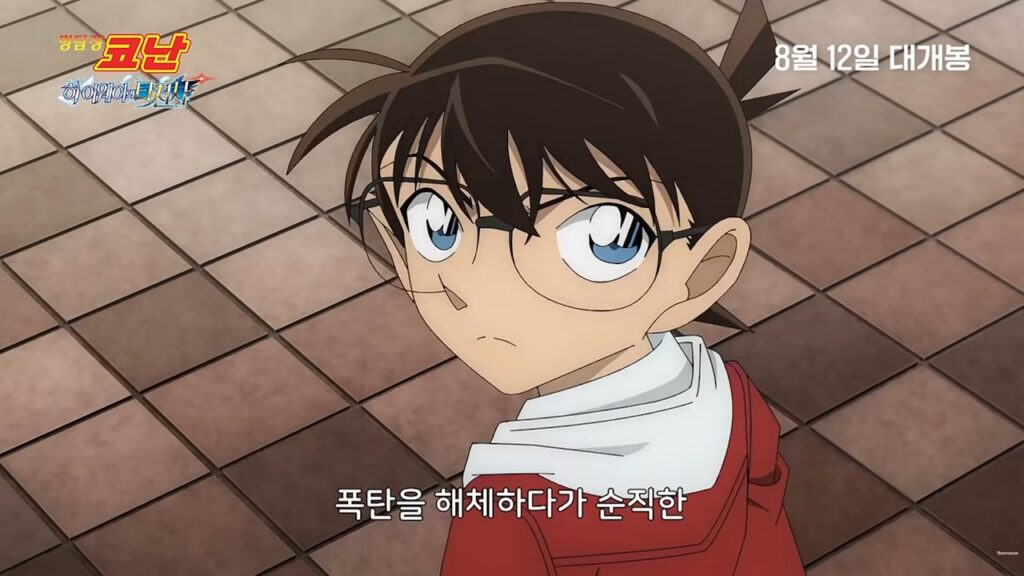
The annual Detective Conan feature often gains its identity from a new location and a specialized group of characters. Detective Conan: Fallen Angel of the Highway opens in South Korean theaters on August 12, 2026, and this installment puts speed, motorcycles, and road-bound investigation at the center. The official Korean promotional channel, Tooniverse, has released a subtitled first trailer, a dubbed main trailer, and a special trailer, all carrying the same opening date. Viewers deciding between subtitled and Korean-dubbed screenings can therefore sample both approaches before booking.
The official Japanese movie site identifies Kanagawa Prefecture as the setting. A published comment from original creator Gosho Aoyama directly highlights energetic motorcycle action and romantic comedy, while playfully warning audiences not to miss what flashes by at high speed. The story also introduces a new white police motorcycle called Angel and Kazuaki Omae, the engineer behind its driving-assistance system. Japanese actor Ryusei Yokohama appears as the guest voice performer for Omae.
Essential Information
- Title: Detective Conan: Fallen Angel of the Highway
- Format: theatrical animated feature in the Detective Conan series
- South Korean theatrical opening: August 12, 2026
- Main setting: Kanagawa Prefecture, Japan
- Central motifs: highways, motorcycle action, police investigation, driving-assistance technology, and Chihaya Hagiwara
- Original creator: Gosho Aoyama
- Guest voice performer: Ryusei Yokohama as Kazuaki Omae
- Official Korean previews: subtitled, dubbed, and special trailers on Tooniverse
- Final booking check: confirm language version, age rating, running time, and bonus-item conditions with the theater
This guide uses only the direction confirmed by the official site and trailers. It does not identify a culprit, motive, victim, or ending. Aoyama's comment also teases the appearance of two people thought to be dead, but expanding that line into named speculation would undermine a surprise the marketing intentionally preserves.
The Starting Point, Without Plot Invention
The film places the visual language of roads and motorcycles inside a mystery. A new white motorcycle, Angel, is connected to the Kanagawa setting, and its developer is presented as an engineer deeply committed to his driving-assistance research. Whether that technology protects people, creates an unforeseen risk, or becomes contested evidence is a question for the film itself. The verified premise gives audiences a machine, its creator, a high-speed environment, and police figures whose work naturally belongs on the road.
Detective Conan movies frequently bring scientific devices, personal history, and emotional motive into the same case. Familiarity with that pattern does not justify inventing the cause of this particular incident. The safe conclusions are narrower: Angel matters, motorcycle action matters, and figures connected to Kanagawa law enforcement have an important role. The official story and staff pages establish a framework while withholding the solution.
Why Chihaya Hagiwara Fits the Center of This Movie
Chihaya Hagiwara is associated with the Kanagawa Prefectural Police motorcycle unit, giving her an immediate connection to the film's road and motorcycle imagery. The title, the high-speed promotional design, and Aoyama's direct reference to her all make it reasonable to expect more than a passing appearance. Her professional decisiveness can bring a field-level form of intelligence to a story in which Conan is also analyzing evidence.
Her exact assignment, the emotional outcome of her relationships, and the choices she makes during the incident should remain unspoiled. Viewers unfamiliar with Chihaya may benefit from a short official character introduction or a related television episode, but a complete series marathon is unnecessary. Theatrical entries generally restate the information required to follow the present case. Existing fans simply bring additional emotional context to the same scenes.
Angel and Its Developer, Kazuaki Omae
The Japanese official site describes Kazuaki Omae as the developer of the latest white police motorcycle, Angel. Ryusei Yokohama's official comment characterizes Omae as an engineer with intense dedication to the driving-assistance system he researches. That setup adds more than a visually striking vehicle. It creates questions about the relationship between speed and safety, the limits of automated support, the responsibility of a designer, and the judgment still required from a human rider.
Those questions are viewing lenses, not predictions. Official material does not prove that Angel causes the case, solves it, or places Omae on any particular side of the conflict. The more rewarding approach is to see how the motorcycle's capabilities become part of the investigation and action rather than assigning guilt from a trailer image.
Ryusei Yokohama's participation is also worth evaluating as voice acting rather than as celebrity decoration. Omae must sound technically passionate while remaining a believable person inside an animated ensemble. The measure of the performance will be how naturally the voice supports the character, not how easily viewers recognize the guest actor.
Signals for Longtime Fans
Gosho Aoyama's official comment combines four enticing elements: Kanagawa, high-tension motorcycle action, romantic comedy, and two people believed to be dead. That last hint is deliberately explosive for established fans, but naming candidates would convert a playful tease into unsupported spoiler speculation. It is enough to note that the creator has signaled a meaningful connection to the past.
The romantic-comedy reference should not be dismissed as a separate decorative subplot. In Detective Conan, promises and long-held feelings often stand beside the criminal mystery, shaping why a character takes a risk or interprets another person's action. One viewing point is how the film places emotional warmth and humor between intense road sequences without allowing either tone to weaken the other.
Six Things to Watch in the Theater
1. Whether the action communicates geography
Fast cutting alone does not create speed. The viewer must understand the motorcycle's position, the direction of a corner, the distance between pursuer and target, and the consequence of a mistake. Clear geography turns motion into suspense.
2. Whether Kanagawa becomes part of the case
A setting is more memorable when its roads, coastal character, and police structure affect the investigation. If Kanagawa functions as a condition of the mystery rather than a label, the film will have a stronger individual identity.
3. The capabilities and limits of Angel
A driving-assistance system becomes dramatically interesting when it interacts with human judgment. Notice whether its functions are explained clearly and whether those functions lead naturally to evidence, danger, or a difficult decision.
4. The relationship between deduction and field action
Conan may analyze information while Chihaya must make immediate decisions on the road. How those two forms of competence connect can determine the balance between mystery and spectacle.
5. The guest performance as character work
Listen for how Ryusei Yokohama conveys Omae's technical conviction and emotional dimension within the fixed timing of animation. Integration matters more than star recognition.
6. The subtitled and dubbed options
Tooniverse has promoted both a subtitled trailer and a Korean-dubbed trailer. A subtitled screening may suit viewers who prioritize the original Japanese performances, while a dubbed screening can make it easier to focus on detailed motion and visual clues. Always check the language label attached to the exact showtime.
Can a New Viewer Follow It?
Knowing the basic premise—that Conan solves cases while living in a child's body—and recognizing a few central figures should be enough to follow the immediate theatrical case. Background knowledge about Chihaya and the Kanagawa police may deepen certain emotional beats, but it is not a reason to avoid the film. Newcomers can watch the official trailers and a concise character guide first, then explore related television episodes after the movie if a particular relationship becomes interesting.
Longtime fans should resist the opposite problem: assuming that every old clue guarantees a specific reveal. A reference can reward continuity without confirming a theory. The safest way to preserve the theatrical experience is to distinguish official hints from fan deduction.
Booking and Bonus-Item Cautions
The Korean opening date is August 12, but the number of subtitled and dubbed showings will vary by cinema and day. Two screenings with the same title may use different voice tracks, so read the notation beside the selected time before payment. Running time and age rating should also be taken from the current booking page.
Theater bonuses may be restricted to certain branches, dates, ticket types, and available quantities. A notice that says distribution ends when stock is exhausted does not guarantee an item for every ticket holder. If a bonus matters to you, consult the theater chain's official event page shortly before visiting rather than relying on an older social post.
Frequently Asked Questions
When does the film open in South Korea?
The official Tooniverse trailers state a theatrical opening date of August 12, 2026. Local first-show times depend on the cinema schedule.
Are both subtitled and Korean-dubbed versions available?
The official Korean channel has released separate subtitled and dubbed previews. Actual screening availability varies, so confirm the language tag on your chosen showtime.
Which new figures are important?
Official material highlights Chihaya Hagiwara and Kazuaki Omae, developer of the new white motorcycle Angel. Ryusei Yokohama performs the Japanese guest voice for Omae.
Who created Detective Conan?
The original manga creator is Gosho Aoyama. His comment for this film is published on the official Japanese movie site.
Must I watch every television episode first?
No. Background knowledge provides extra context, but the present case should remain understandable to a newcomer. A short character refresher is enough preparation for most viewers.
Where should I check theater bonuses?
Use the official event page of the cinema chain and the official Korean promotional channel. Types, participating locations, and remaining quantities can differ and may change quickly.
Final Take
Detective Conan: Fallen Angel of the Highway brings together Kanagawa's roads, Chihaya Hagiwara, the white police motorcycle Angel, and questions surrounding driving-assistance technology. The key test is not simply whether the motorcycles move faster than before, but whether speed, human judgment, and deduction become parts of the same mystery. Confirm the subtitled or dubbed label and any bonus conditions before your August 12 screening, then leave the culprit and the meaning of the creator's hints for the movie to reveal.