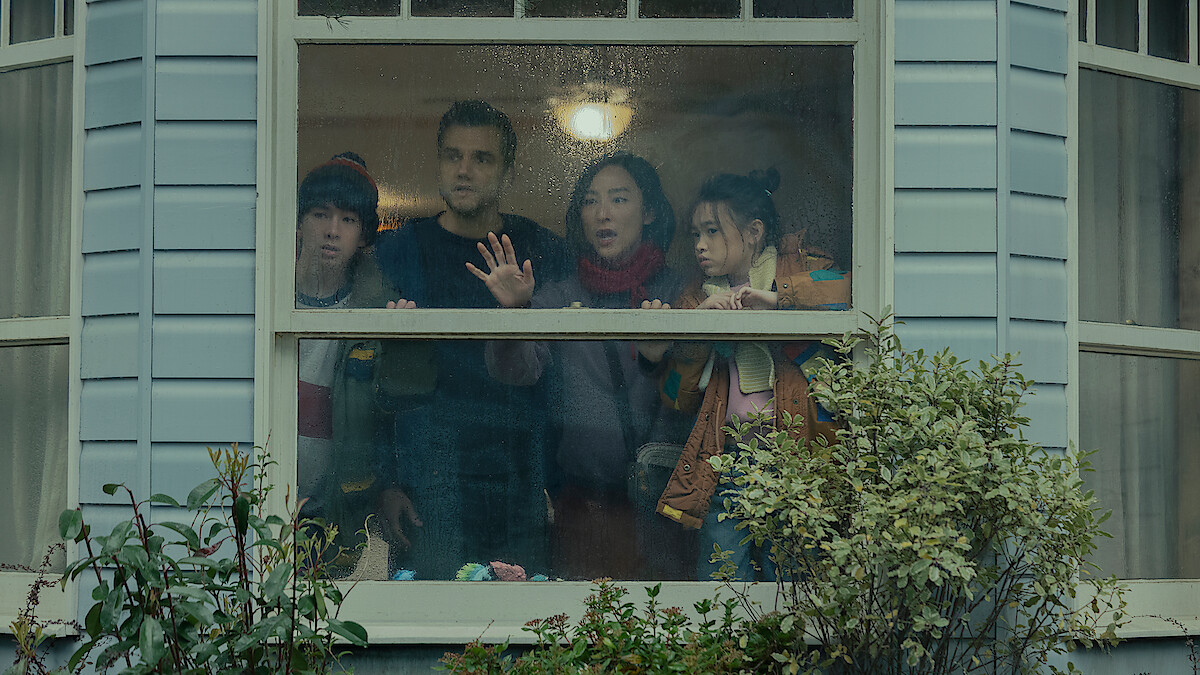
The Last House (2026)

| Item | Details |
|---|---|
| Title | The Last House (2026) |
| Key topics | The Last House, Netflix movie, Greta Lee, Wagner Moura, sci-fi thriller, survival movie |
| Information checked | August 11, 2026 |
A home is supposed to be the place where danger stops at the door. The Last House, a 2026 Netflix original, turns that assumption into the source of its terror. A family wakes to discover that their own house has become a sealed environment. There is no obvious route out, supplies are finite, and an ominous force remains outside. The film does not begin by sending its characters across a ruined continent. Instead, it makes familiar rooms, windows, hallways, and household objects the boundaries of an escalating survival problem.
One distinction matters before going any further. This is the 2026 Netflix science-fiction thriller starring Greta Lee and Wagner Moura and directed by Louis Leterrier. It should not be confused with older horror or exploitation films that have similar titles. The year, the two lead actors, and the Netflix platform are the clearest identifiers.
Release details at a glance
- Title: The Last House
- Streaming date: August 7, 2026
- Platform: Netflix
- Runtime: 1 hour 52 minutes
- Genre: science fiction, thriller, horror, survival drama
- Director: Louis Leterrier
- Writer: Matthew Robinson
- Principal cast: Greta Lee, Wagner Moura, Riley Chung, Noah Alexander Sosnowski, Emma Ho, and Gabriel Barbosa
Netflix's official synopsis says that a family mysteriously sealed inside its home must work together as its resources dwindle and the force keeping everyone trapped grows more threatening. That short description establishes the central engine without revealing the mystery. The urgent question is not simply whether someone can overpower an attacker. It is how long a household can function when food, water, certainty, privacy, and hope are all under pressure.
The premise without the ending
Greta Lee plays Ann and Wagner Moura plays Jason, the parents at the center of a family of four. Their children are Ruth and Graham. Official trailer material reveals an important aspect of the film's scale: one day becomes three days, then a week, and eventually years. Riley Chung and Noah Alexander Sosnowski play the children at a younger age, while Emma Ho and Gabriel Barbosa portray their older versions as time advances. This is not merely a one-night home-invasion setup. The sealed house becomes an environment in which a family has to build a continuing life.
That passage of time changes the meaning of every survival choice. An emergency meal can solve tonight's problem but worsen next month's shortage. A rule created to keep children safe can become unbearable as they grow. Parents who remember the outside world may understand the house differently from children whose lived world has been reduced to those walls. The official material deliberately leaves the cause of the confinement and the exact nature of the threat unresolved. Viewers are therefore free to focus on the film's two linked mysteries: what is outside, and what prolonged confinement will do to the people inside.
Director Louis Leterrier describes the story as a challenge to the idea of the home as a safe haven. The house becomes hostile, and survival requires unity while exposing how fragile security can be. Moura has said that he connected with the thought of waking up physically sealed inside a home without understanding why. Lee, meanwhile, was drawn to survival stories that contain a twist and to the questions the screenplay asks about how people choose to live. Those comments suggest that the speculative hook is meant to carry an emotional and social argument, not just a succession of scares.
Ann, Jason, and the family's emotional architecture
Lee has described Ann as the rock of the family: an ordinary mother whose physical and emotional strength becomes extraordinary under extreme danger. That description is useful because it prevents Ann from being reduced to a passive victim waiting for an explanation. Her power is rooted in care, persistence, and the need to keep the household emotionally intact when the environment no longer supports normal life.
Jason is also presented as more than a conventional action hero. Moura describes him as a father and fierce protector who has to project calm while everything is falling apart. He must also look inward and determine how he can actually guide his wife and children through the crisis. The pairing is promising. Lee's work in Past Lives and Russian Doll has demonstrated precision with interior emotion, while Moura's roles in Narcos and The Secret Agent have shown intensity, authority, and vulnerability. A film built around confinement needs faces and relationships capable of creating movement even when the physical setting remains restricted.
The dual casting of Ruth and Graham adds another dimension. A child who enters the crisis expecting adults to provide answers may become a young adult who has never received them. The parents' promise of safety may change meaning as years pass. The house can remain shelter, prison, classroom, memory, and the whole known world at once. The official sources do not disclose the final direction of these relationships, and viewers are better served by discovering those developments in the film itself.
The filmmakers behind the walls
Louis Leterrier is known for energetic genre work, including Now You See Me and the Netflix series Lupin. Here, the scale is concentrated inside a family residence. In Netflix's trailer feature, Leterrier cites the tactile quality of Steven Spielberg and Amblin films, in which houses feel lived-in and relatable, and says the crew relied on practical effects as much as possible. That approach is especially appropriate for this premise. A visibly ordinary home makes its transformation into a trap more unsettling than an abstract futuristic bunker would be.
Matthew Robinson wrote the screenplay. His credits cited by Netflix include Love and Monsters, Dora and the Lost City of Gold, and The Invention of Lying. Leterrier also produced alongside Peter Chernin, Jenno Topping, Kori Adelson, and Oly Obst. The production consulted survival specialist Megan Hine to devise innovative but believable ways in which the family might endure. That detail is worth watching for. The film's credibility depends not only on the mystery but also on practical decisions about food, tools, space, routines, and adaptation.
Yair Elazar Glotman composed the score. He has explained that the music follows the family's emotional trajectory, beginning with intimate warmth and subtle mystery before expanding into heavier brass, aggressive percussion, distorted strings, and larger orchestral gestures. He also designed the main theme to have two natures: comforting when associated with family togetherness and eerie when the outside danger presses inward. The musical idea mirrors the film's central visual contradiction. Home is still where love lives, but home is also the site of dread.
Five viewing points to watch closely
1. The changing geography of the house. A kitchen, corridor, bedroom, or window can acquire a new function as time and supplies run out. Notice how framing and practical details make the same space feel different.
2. Survival rules and family power. Rules may be necessary, but the person who makes them also controls everyone else's life. Watch whether cooperation remains voluntary as the crisis becomes permanent.
3. The treatment of time. The younger and older versions of the children indicate that the story crosses years. Costumes, rooms, routines, and performances can all show the weight of that duration.
4. The boundary between practical survival and speculative horror. The family faces concrete shortages while an unexplained force creates a science-fiction mystery. The most interesting moments may be where those two levels intersect.
5. The score's double identity. Glotman's warm family material is designed to mutate under pressure. Listening for those changes can reveal how the film turns sanctuary into menace before the characters say what they feel.
Tone and content considerations
Netflix categorizes the movie across science fiction, horror, thriller, survival, post-apocalyptic, and supernatural territory, describing it as scary, emotional, suspenseful, and focused on a family in danger. Viewers sensitive to claustrophobia, dwindling necessities, endangered children, or prolonged domestic confinement should take that tone into account. At the same time, promotional summaries that claim to reveal the creatures, the ultimate cause, or the ending should be avoided before viewing. Netflix has published separate ending-oriented coverage, which is itself a reason to stay away from related headlines until the film is over.
Frequently asked questions
Where can I watch The Last House? It began streaming on Netflix on August 7, 2026.
How long is it? Netflix and Tudum list a runtime of 1 hour and 52 minutes.
Who plays the parents? Greta Lee plays Ann and Wagner Moura plays Jason.
Who plays Ruth and Graham? Riley Chung and Noah Alexander Sosnowski play the younger children, and Emma Ho and Gabriel Barbosa play their older counterparts as the story moves through time.
Is this a remake of an older similarly titled horror film? Netflix's official materials present it as an original science-fiction thriller written by Matthew Robinson. It is important to identify it by its 2026 date, cast, and platform rather than assume a connection to an older title.
Should I read an ending explanation first? No. The unknown force, the evolving threat, and the family's adaptation form the movie's central mystery. The basic setup is enough preparation.
The appeal of The Last House lies in its proximity. It does not ask audiences to imagine survival somewhere remote; it closes the door on a recognizable family and forces every ordinary object to matter. With Lee and Moura carrying the emotional center, children aging inside the crisis, a practical-effects sensibility, specialist survival input, and music designed to turn warmth into dread, the film offers more than a puzzle about what is outside. It asks what remains of safety, parenting, childhood, and love when a home is both the only refuge left and the one place no one can leave.