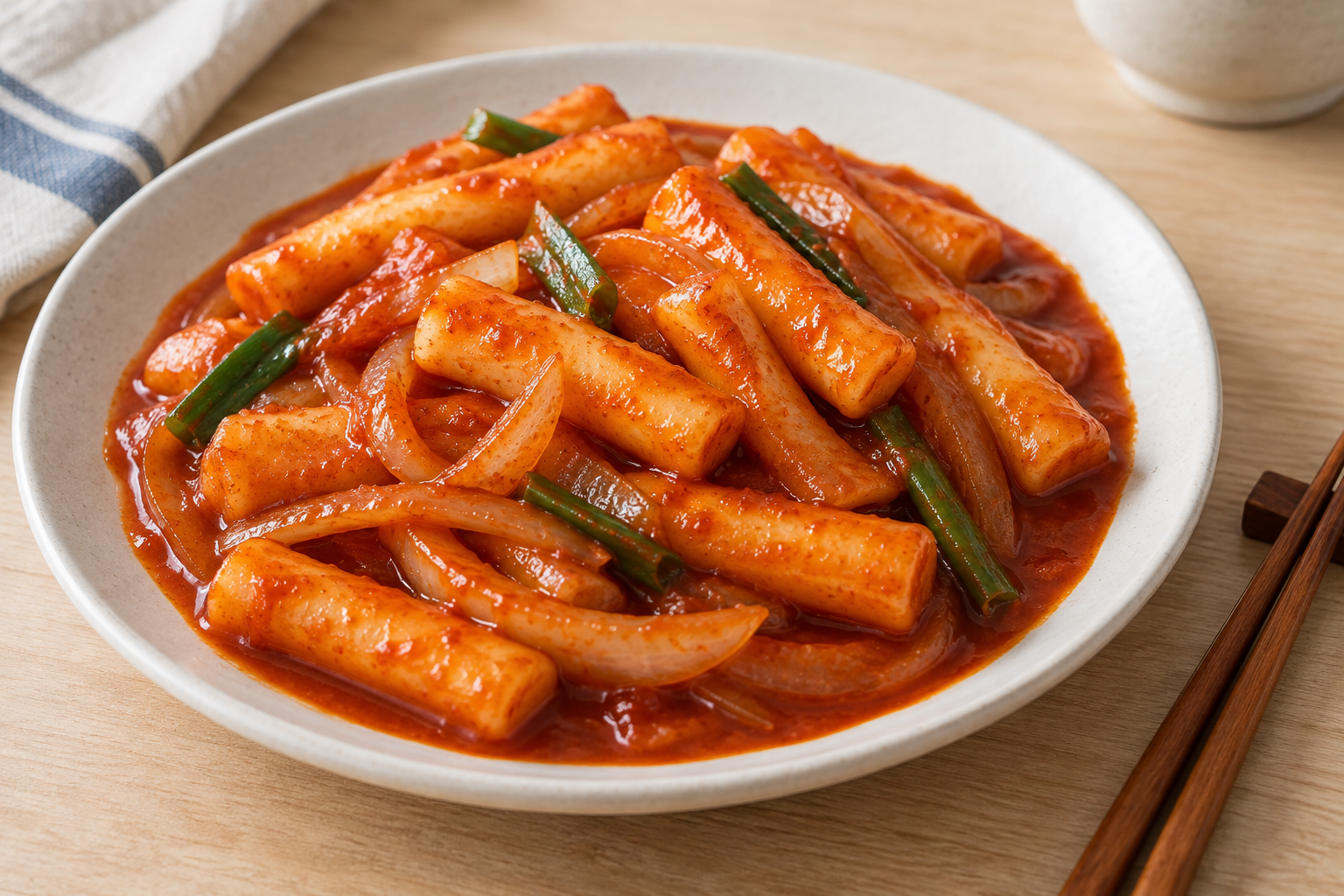
Is your sauce getting thick while the rice cakes are still hard? Good tteokbokki starts with watching both the rice cakes and the liquid in the pan. This small-batch guide uses Korean rice cakes, onion and scallion, with water instead of stock. No fish cakes or eggs are needed. Start with the measured sauce, then adjust after the rice cakes soften.
Yield: 2 snack or light-meal portions
Estimated time: 10 minutes prep, plus about 12–18 minutes cooking; firm rice cakes may need extra soaking time.
Measurements: 1 tablespoon = 15mL; 1 teaspoon = 5mL. Use measuring spoons, not table cutlery.
All four images are AI-generated illustrations, not photographs of a cooking test. Follow the written quantities and doneness cues rather than counting ingredients in the images. Cooking times vary with the rice cakes and stove.
Ingredients for two
- 350g Korean cylindrical rice cakes for tteokbokki (about 12.3oz)
- 450mL water, plus extra to adjust the sauce
- 2 tablespoons gochujang, Korean red chili paste
- 1 tablespoon sugar
- 1 teaspoon regular soy sauce to start
- 1 teaspoon gochugaru, Korean chili flakes, optional
- 80g onion, thinly sliced
- 25g scallion, cut into 3cm pieces; keep white and green parts separate
Use a deep-sided skillet about 24cm (9½ inches) across, a measuring jug, measuring spoons and a spatula. Water evaporates faster in a wider pan. If your pan is a different size, use the texture and sauce cues below instead of forcing the recipe to match a timer.

What to buy at a Korean grocery store
Look for a bag labeled tteokbokki rice cakes or 떡볶이떡. These are dense, chewy cylinders, not the crisp puffed rice cakes sold as snacks. This recipe uses short rice-based cylinders. Thin oval rice cakes for soup cook differently, so do not give them the same cooking time automatically.
Read the package for storage, thawing and soaking instructions. Fresh, soft rice cakes need less preparation than firm refrigerated ones. Gochujang is a fermented chili paste; it is not interchangeable spoon-for-spoon with sriracha or another vinegar-based hot sauce. Check its heat rating when buying it.
Allergen check: Rice-based tteok does not make the whole dish gluten-free. Soy sauce and gochujang may contain wheat or soy. Read every ingredient and cross-contact label. Although this version contains no fish cakes or meat stock, check packaged ingredients before calling it vegan or suitable for a particular allergy.
1. Prepare the rice cakes
Follow the package directions first. If the manufacturer permits soaking, firm refrigerated rice cakes can be soaked in cool water for about 15–20 minutes and drained. Fresh, pliable ones may not need this. Follow the thawing instructions for frozen tteok; do not leave it out for hours. Let stuck pieces loosen before pulling them apart to avoid cracks.
2. Dissolve the sauce before adding the tteok
Put 450mL water, 2 tablespoons gochujang, 1 tablespoon sugar and 1 teaspoon soy sauce into the pan. Stir until the paste is evenly dispersed. Add the optional gochugaru, sliced onion and white scallion pieces. Bring to a simmer over medium heat. Do not spend a long time reducing the sauce at this stage.

3. Simmer until the centers soften
Add the rice cakes. Once the pan returns to a simmer, lower the heat to medium-low. Stir gently and regularly to prevent sticking. Begin checking the texture at around 10 minutes; add the green scallion pieces for the last 2–3 minutes. Allow roughly 12–18 minutes of cooking, but give the product instructions and the actual texture priority.
Lift out one piece and let it cool before checking the center. It should be soft and chewy rather than firm in the middle. If the sauce thickens before that happens, add water 2 tablespoons (30mL) at a time and keep the pan at a gentle simmer. Avoid vigorous stirring once the rice cakes soften.

4. Finish while a little sauce remains
Stop when the cooked rice cakes have a light coating of sauce and there is still some sauce in the pan. It can thicken further as the dish cools. Taste a cooled spoonful; add soy sauce only if needed, in ½-teaspoon increments. Serve while warm, allowing each bite to cool enough to eat comfortably.

Adjustments that are easier to control
- Less heat: Omit gochugaru and start with 1 tablespoon gochujang. It may still be spicy. Adjust the saltiness with a little soy sauce at the end; adding lots of sugar does not remove the chili.
- Sauce too thin: Once the rice cakes are cooked, simmer uncovered for another 1–2 minutes at a time. Recheck before adding anything. A starch slurry is usually unnecessary because the rice cakes already contribute starch.
- Sauce too thick or slightly salty: Add water in 30mL increments. A severely oversalted batch may require changing the ratio of unseasoned ingredients to sauce; a tiny splash cannot fix everything.
- One portion: Start with 175g tteok, 225mL water, 1 tablespoon gochujang, ½ tablespoon sugar, ½ teaspoon soy sauce, 40g onion and about 12g scallion. Use a smaller pan and watch evaporation. The cooking time is not automatically halved.
- Four portions: For a similar result in the same skillet, make two batches. Do not assume a crowded double batch simply needs twice the cooking time.
Cooling, storing and reheating
Making only what you need gives the best chance of keeping the intended texture. Divide leftovers into shallow containers and refrigerate at 4°C (40°F) or below within 2 hours; use a 1-hour limit if the surrounding temperature is above 32°C (90°F). Do not leave a large pan on the counter until completely cold. For reheating, add a little water and heat thoroughly; a food thermometer should read 74°C (165°F) in the food. Reheating does not make food safe after prolonged unsafe storage.
Rice cakes can firm up in the refrigerator, and reheating may not fully restore the original texture. Follow any stricter instructions on the ingredient packaging and consult the official food-safety guidance below for general leftover handling.
Sources and more Korean recipes
Korean Bapsang’s tteokbokki guide informed the notes on rice-cake types and cooking principles. The quantities here are a separate two-portion, no-fish-cake version, not a claim that the source tested this exact formulation. General handling guidance: FoodSafety.gov: Four Steps to Food Safety.
Gamjajeon: Korean potato pancakes · Gyeran mari: Korean rolled omelet · 한국어 버전
답글 남기기