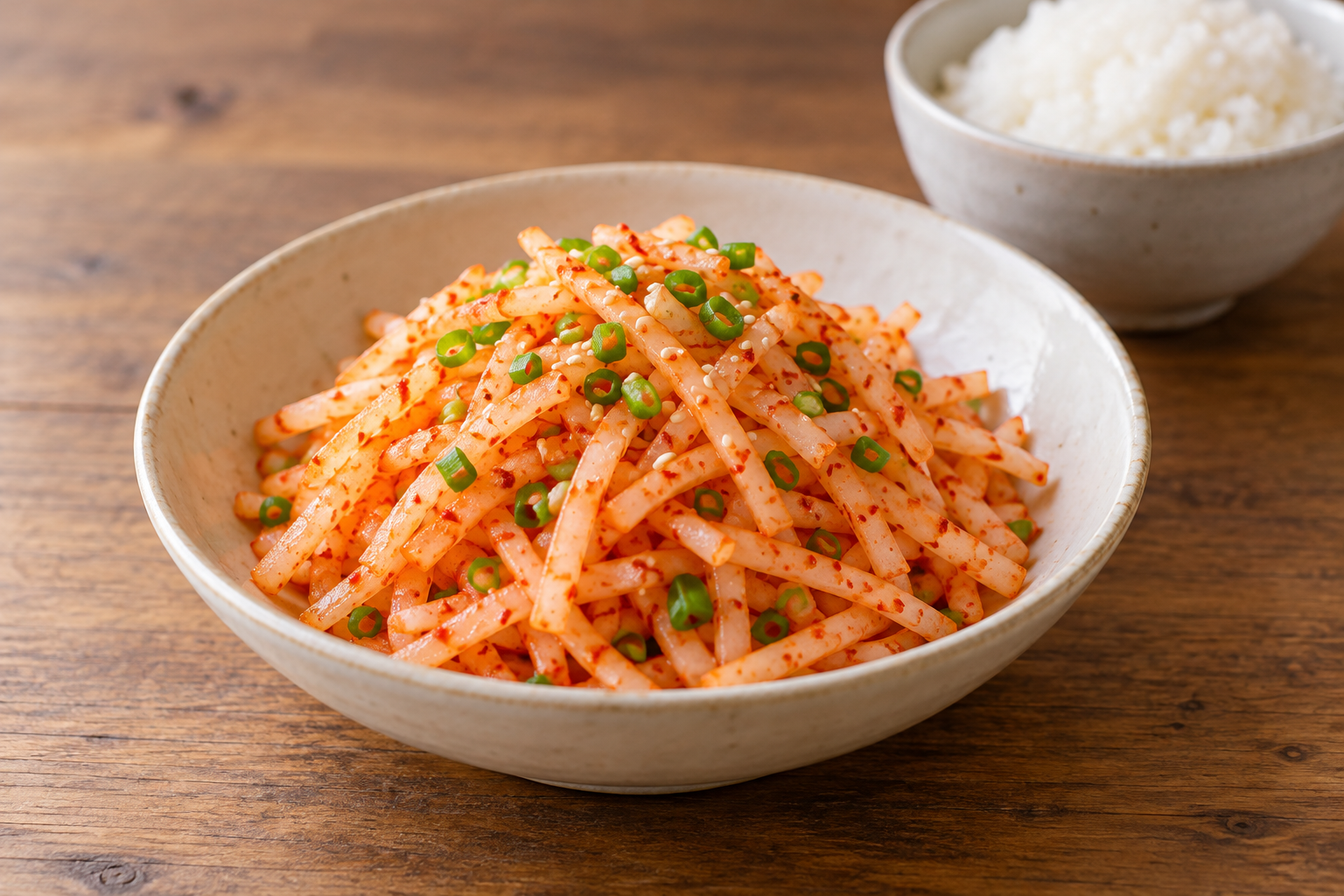
Musaengchae (무생채) is a Korean side dish made with fine strips of raw radish. This version starts with 400g of trimmed radish and uses gochugaru, vinegar and salt for a lightly spicy, tangy banchan. It contains no fish sauce or soy sauce and is intended to be eaten fresh, rather than fermented like kimchi.
Yield: 3–4 small side-dish servings. Estimated time: 20–25 minutes, including a 10-minute salting rest; allow longer if you are new to julienning. Cooking: none. This is a measured preparation guide, not a claim of personal cooking or tasting experience. All four images are AI-generated process illustrations; they do not document an actual cooking session or exact ingredient quantities.
Jump to ingredients · Method · Troubleshooting · 한국어 레시피 보기 →
Ingredients for 400g of prepared radish
- 400g Korean radish (mu), weighed after trimming and peeling as needed; about 14oz
- 3g salt for the brief salting stage; weigh it because crystal size changes spoon measurements
- 6g gochugaru (Korean red pepper flakes), approximately 1 tablespoon; adjust for heat
- 15mL unseasoned vinegar with around 5% acidity, up to 1 tablespoon
- 6g sugar, up to approximately 1½ teaspoons; start with half for a sweet radish
- 3g minced garlic and 10g finely sliced scallion
- 3g toasted sesame seeds, approximately 1 teaspoon, optional
A tablespoon means 15mL and a teaspoon means 5mL here. Gram amounts are the main reference for dry ingredients. Choose plain rice or other unseasoned vinegar; concentrated vinegar and sweetened sushi vinegar are not direct volume-for-volume replacements. The base formula does not include fish sauce, soy sauce or sesame oil.

Choosing radish and setting up the workspace
Korean mu is a broad white radish, often with a pale green shoulder. Choose a firm specimen without soft or rotten patches. If its cut interior is dry and spongy, choose another radish for a raw salad. Daikon can be used when mu is unavailable, but its moisture, sweetness and peppery bite may change the seasoning balance. Do not assume that any radish will taste identical after adding the same dressing.
Prepare a large bowl, sharp knife, stable cutting board, colander, scale, measuring spoons and a clean storage container. Wash hands and utensils and keep them separate from raw meat equipment. Rinse the radish under running water before peeling, then dry it. Do not wash produce with soap or detergent.
1. Cut even matchsticks
Divide the radish into manageable sections about 5cm (2 inches) long. Trim one curved side to make a flat base and rest that base on the board. Slice into 2–3mm sheets, then cut the sheets into matchsticks of the same width. Consistent thickness matters more than perfectly matching the length: very thin pieces soften sooner than thick ones.
If using a mandoline, use its hand guard and stop before the last small piece becomes difficult to hold safely. A knife is entirely adequate; there is no need to buy a special tool for this recipe.

2. Salt briefly, then drain
Toss the 400g of radish with 3g salt, distributing it through the bowl. Rest for about 10 minutes, turning gently once midway. Look for a little released liquid and strips that bend slightly but do not fall apart. Radish moisture and cut thickness can change how quickly this happens.
Transfer to a colander, discard the liquid and press gently to remove surface moisture. Do not wring the strips aggressively. The base method does not rinse the radish. If a strip tastes excessively salty, give it a brief cold-water rinse, drain well again and omit any additional salt while adjusting the dressing. Some salt leaves with the drained liquid, so the added salt is not an exact measurement of the finished dish’s sodium content.
3. Coat with gochugaru, then add the dressing
Return the drained radish to the bowl and lightly toss with 6g gochugaru. Add 3g sugar, 10mL vinegar and 3g minced garlic. Lift and fold the strips rather than kneading or crushing them. Taste, then add some or all of the reserved 3g sugar and 5mL vinegar as needed. A sweeter radish or a preference for gentler acidity may call for less than the full amount.

4. Finish with scallion and serve
Fold in 10g sliced scallion and the optional 3g toasted sesame seeds. Taste one or two evenly dressed strips before considering more salt: salt was already used in the first stage. If genuinely underseasoned, add a small pinch at a time and taste again. For a rice bowl or bibimbap, lift out the radish rather than pouring in all the liquid from the mixing bowl.

Troubleshooting the texture and seasoning
- Liquid collects after mixing: Salt and sugar can draw out more moisture over time. Serve the portion you need and drain thoroughly after salting next time. Repeatedly adding gochugaru to absorb the liquid may make the dish too hot.
- Too salty: Add a little unseasoned radish to dilute the seasoning across more vegetables. Sugar and vinegar do not remove salt. For a heavily oversalted batch, adjust a small portion first instead of committing more ingredients to the entire bowl.
- Radish is sharply peppery or garlic dominates: Start with only 1–2g garlic next time or choose a different radish suited to raw eating. This preparation has no heating step to mellow a strongly peppery radish.
- Too sour or sweet: Stop before adding the reserved vinegar or sugar. Extra plain radish can rebalance a small batch. If you used concentrated vinegar, restart the seasoning calculations with an ordinary-strength product.
- Strips become limp: Check for extremely fine cutting, prolonged salting, hard squeezing or vigorous mixing. More vinegar cannot reliably reverse a damaged texture.
Half and double batches
For 200g radish: 1.5g salt, 3g gochugaru, up to 7.5mL vinegar, up to 3g sugar, 1.5g garlic, 5g scallion and optional 1.5g sesame seeds. For 800g radish: 6g salt, 12g gochugaru, up to 30mL vinegar, up to 12g sugar, 6g garlic, 20g scallion and optional 6g sesame seeds.
Doubling the radish does not mean doubling the salting time. Use a larger bowl or work in two batches so that the salt is distributed evenly, then judge the strips themselves. Start below the maximum dressing quantities and adjust. Omitting the sesame seeds does not require increasing another ingredient.
Refrigeration and using the remaining radish
Serve a small portion and refrigerate the rest promptly in a clean covered container. Do not return leftovers from a shared serving plate to the storage container. UK Food Standards Agency guidance recommends a fridge at 0–5°C and eating leftovers within 48 hours. Here, making a small batch and using it within that window is a conservative approach, not a tested shelf-life guarantee regardless of ingredient condition or time spent out of refrigeration.
Vinegar and salt do not make this an ambient-stable preserve or a validated pickling recipe. Discard food with mold, slime or an unusual smell, and do not rely on normal smell alone to establish safety. Freezing and thawing can change the crisp texture, so it is not recommended for serving this salad in its original style. Keep the remaining unprepared radish refrigerated according to its storage instructions and use it in soup or a cooked side dish rather than enlarging the salad unnecessarily.
Allergens, references and more banchan
The optional sesame seeds are an allergen. Omit them when necessary and check packaged ingredients and cross-contact statements. Leaving out fish sauce and soy sauce does not by itself establish suitability for every dietary restriction.
Maangchi’s musaengchae and Korean Bapsang’s musaengchae were consulted for the basic preparation and its variations. This article presents a separate 400g, briefly salted formula rather than reproducing either source’s ingredient ratios. See the FDA’s produce preparation guidance and UK Food Standards Agency chilling guidance for handling and storage. Sources checked October 22, 2026.
For another tangy side, try Oi Muchim: Korean Cucumber Salad. For a mild cooked accompaniment, see Hobak Bokkeum: Korean Zucchini. Browse K-Food recipes · 한국어 레시피 →
답글 남기기