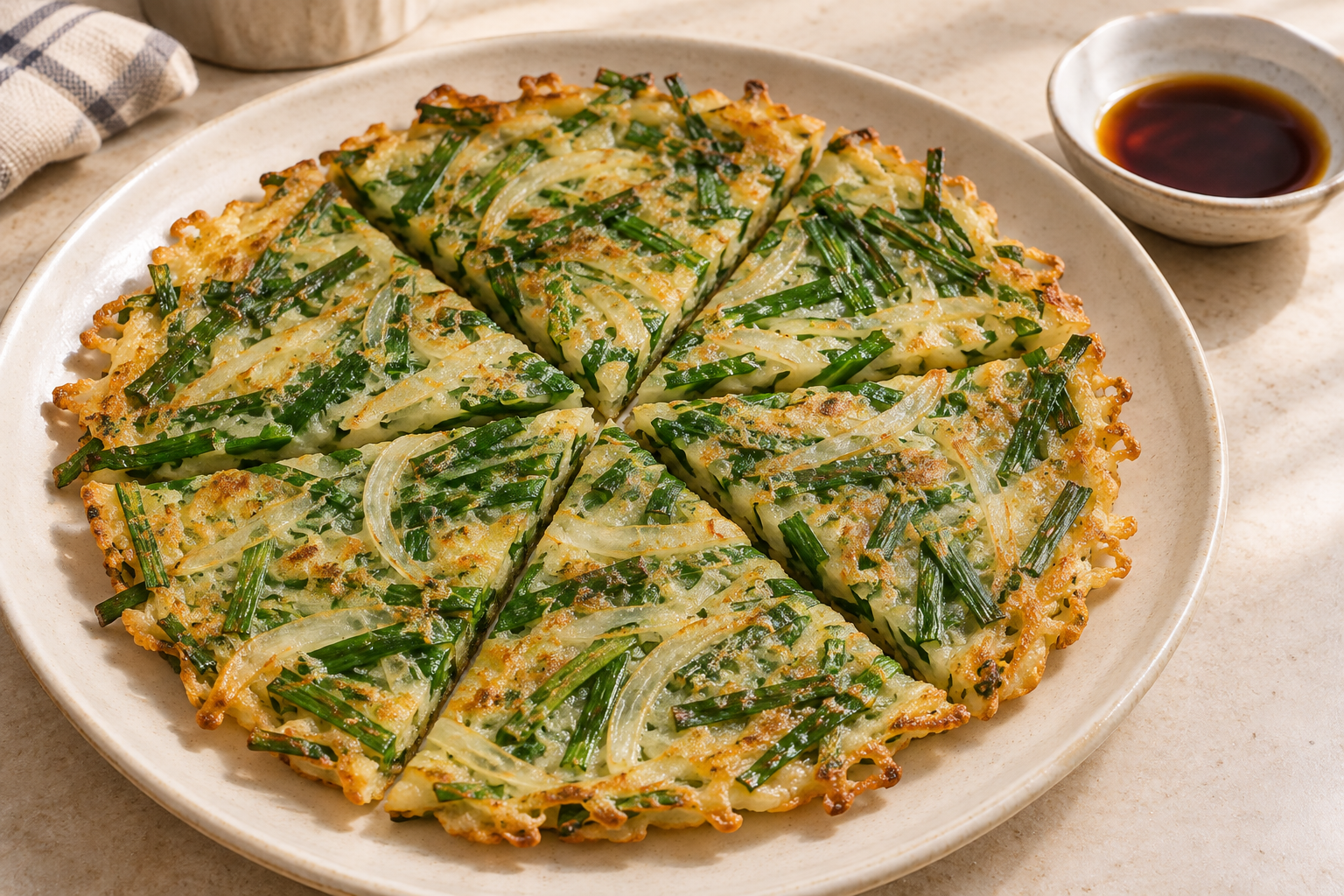
Buchujeon is a Korean savory pancake made with flat garlic chives. For crisp edges, dry the chives after washing and cook the batter in two thin rounds. A little potato starch keeps the batter light, and each round fits comfortably inside a 24 cm (9½ inch) skillet.
Makes two 18–20 cm pancakes, enough for 2–3 as a side. Allow about 10 minutes to prep and 12–16 minutes to cook. The four images are AI illustrations of the steps.
Ingredients and equipment
- 120 g trimmed garlic chives (buchu), plus 35 g white or yellow onion
- 80 g all-purpose flour, 20 g potato starch, 1.5 g fine salt
- 125 mL cold water, with 5–10 mL more if needed
- 30 mL neutral cooking oil (2 tablespoons), divided
- Optional dipping sauce: 15 mL regular soy sauce, 5 mL vinegar, 10 mL water
- A 24 cm nonstick skillet and a wide spatula

1. Dry the garlic chives and cut them short
Look for garlic chives at Korean or other East Asian groceries. Their leaves are flat and have a mild garlicky aroma. Trim bruised ends, rinse the chives, and drain them in a sieve. Pat the stems and leaves dry before weighing out 120 g. Cut them into pieces about 4 cm (1½ inches) long, then slice the onion about 2 mm thick. Short pieces spread more evenly and are easier to cut after cooking.
2. Mix a thin batter just before frying
Combine the flour, potato starch, and salt. Pour in 125 mL cold water and stir until the dry patches disappear. Break up large lumps with a spatula, then fold in the garlic chives and onion with a few strokes.
The batter should cling to the strips in a thin coat. If the chives sit in a stiff bundle, add water 5 mL at a time. If you see a large pool of runny batter underneath the vegetables, mix in 5 g flour and check again. The amount of surface water left on the chives can change what the batter needs.

3. Spread half the mixture in the skillet
Set the skillet over medium heat and swirl in 10 mL oil. Drop in a little batter to check the heat. Once small bubbles form around it, spread half the chive mixture into a thin round about 18–20 cm (7–8 inches) wide. Push any thick tufts of chives out toward the edges. If the oil smokes, lower the heat and let the pan cool briefly before adding the mixture.
4. Flip when the first side holds together
Cook the first side for about 3–4 minutes over medium heat. Slide a wide spatula under an edge when it looks dry and set. If the underside is golden and the round lifts in one piece, flip it. If the middle still shifts like liquid, give it another 30 seconds and check again.
Add 5 mL oil around the edge after flipping and cook the second side about 2–3 minutes. Check the thickest part for wet flour batter and continue at slightly lower heat if needed. Repeat with the remaining batter, using the last 15 mL of oil in the same split.

5. Let steam escape before serving
Set the pancakes on a wire rack in one layer for about a minute, then cut into wedges. Stacking the pancakes while hot traps steam against the cooked sides. Mix the soy sauce, vinegar, and water for dipping. For a second savory pancake, see Korean kimchi pancakes.

Fix tearing, a soggy center, or too much oil
- Tearing: Wait for the bottom to release and support as much of the round as possible with the spatula. Make smaller rounds if the skillet is narrow.
- Dark edges and a wet center: Lower the heat and finish cooking the middle. Spread the next round thinner and smooth out any chive piles.
- Greasy surface: Check pan heat and thickness before adding more oil. Transfer cooked pancakes to a wire rack so steam and excess oil have somewhere to go.
Scale the batch or make substitutions
For one pancake: Use 60 g garlic chives, about 18 g onion, 40 g flour, 10 g potato starch, about 63 mL water, 0.75 g salt, and 15 mL oil. For four: Double the ingredients and fold the vegetables into the batter in two batches. Cook each round individually for even browning.
Cornstarch can replace the potato starch by weight. If using a seasoned Korean pancake mix (buchimgaru), follow its water instructions and leave out the extra salt until you know how the mix is seasoned. This recipe contains wheat, and the dipping sauce contains soy and may also contain wheat.
Store leftovers and reheat in a pan
Refrigerate leftovers in a single layer within 2 hours, or within 1 hour above 32°C (90°F). Keep the fridge at 4°C (40°F) or below and use within 3–4 days, or freeze. To reheat, warm both sides over medium-low heat in a dry skillet until the center reaches 74°C (165°F).
Recipe and food-safety references
For a traditional garlic chive pancake method, see Korean Bapsang’s buchujeon. For cooling, storage, and reheating temperatures, see FoodSafety.gov guidance on leftovers.
답글 남기기