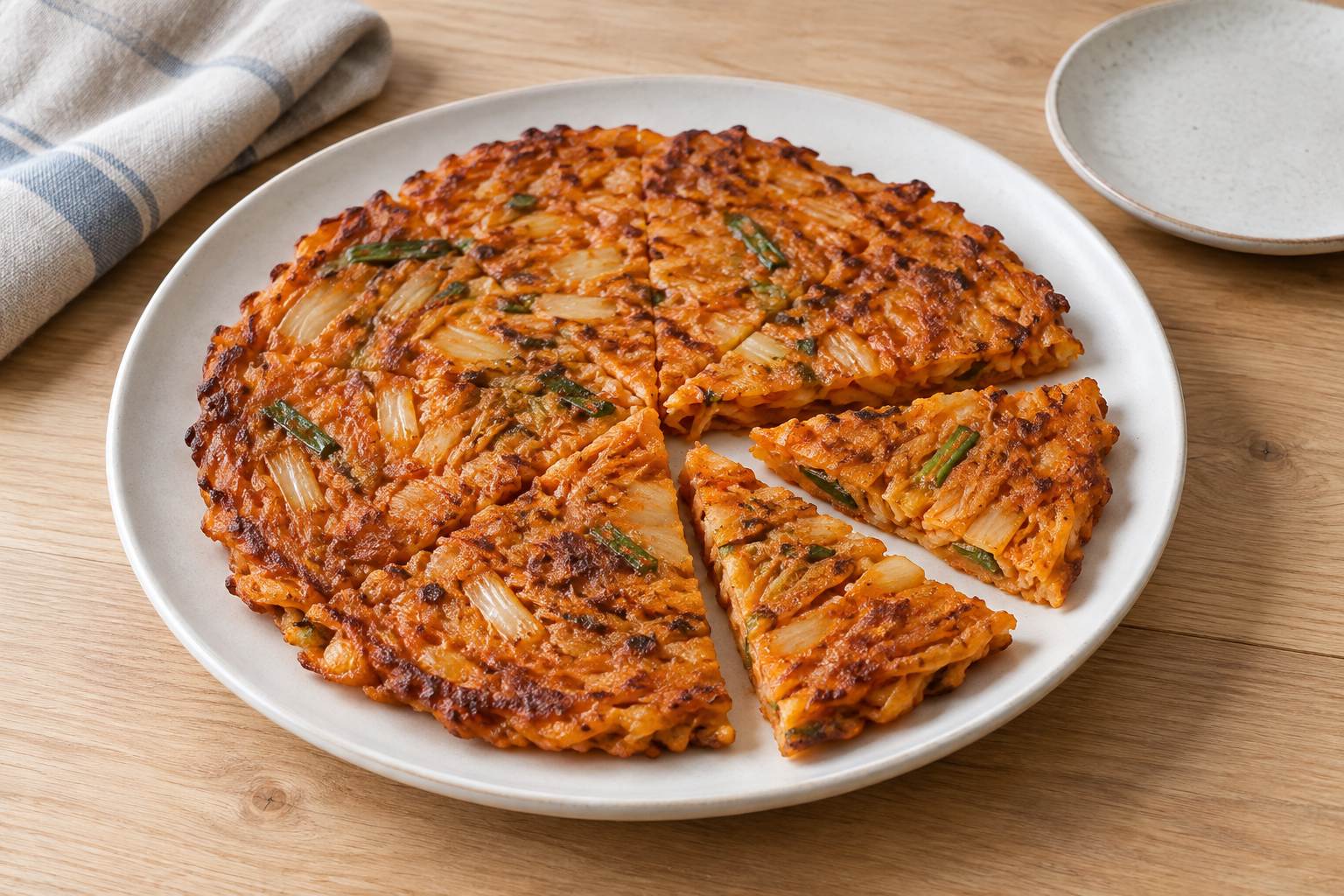
Kimchi jeon is a savory Korean pancake made with kimchi and a simple flour batter. It is not a sweet breakfast pancake. This small-batch guide uses 200g of kimchi and makes about three 18–20cm pancakes for two people. The useful checkpoints are how the batter pours, whether the base has set, and whether the center is cooked.

Estimated time: 10 minutes preparation + 15–20 minutes cooking
Equipment: kitchen scale, measuring spoon, mixing bowl, 24–26cm / 9.5–10-inch skillet and a broad spatula
Timing and yield depend on your pan, heat and pancake thickness.
Ingredients: measure the kimchi brine separately
| Ingredient | For two |
|---|---|
| Fermented napa cabbage kimchi | 200g / about 7oz, plus the measured brine below |
| Plain all-purpose flour | 80g / about 2.8oz |
| Potato starch or cornstarch | 20g / about 0.7oz |
| Cold water | Start with 150mL |
| Kimchi brine | 30mL / 2 tablespoons of 15mL each |
| Onion / scallion | 30g onion / 10g scallion |
| Cooking oil | About 30mL total, divided among the pancakes |
The gram amounts are the main measurements; flour packed into a cup can vary. Water 150mL equals ten 15mL tablespoons. Do not use a sweetened pancake mix as a direct replacement. Kimchi supplies seasoning, so the base recipe adds no salt or soy sauce.
If you have no starch, start with 100g plain flour in total and expect a different texture. Korean pancake mix, called buchimgaru, can replace the combined flour and starch at 100g, but check its seasoning and ingredients first. Replace any missing brine with the same volume of water, then assess the seasoning after cooking the first pancake.

Method: use a small first pancake as your checkpoint
- Prepare. Cut the kimchi into roughly 1cm / ⅜-inch pieces, slice the onion thinly and chop the scallion. Long cabbage strips can catch on the spatula. Fermented sourness is not the same as spoilage; do not use kimchi that appears moldy or otherwise spoiled.
- Mix. Combine 80g flour and 20g starch. Add 150mL cold water and 30mL brine, mixing just until the dry flour disappears. Fold in the kimchi, onion and scallion.
- Check the batter. It should run slowly from a tilted spoon rather than fall in a solid lump. Add water 5–10mL at a time if it is too stiff. If the liquid separates widely from the kimchi, mix in a little flour and reassess. Do not taste uncooked batter.

- Spread. Warm the skillet over medium heat and add about 10mL oil. Reduce the heat if the oil smokes. Spread about one-third of the batter into a thin 18–20cm pancake. Make smaller pancakes if your skillet is smaller.
- Flip when the base sets. Start checking the first side at about three minutes. Look for firm edges and a base that releases enough for a broad spatula to slide beneath it. Support the pancake and turn it over. Check the second side after roughly two to three minutes; continue until there is no wet flour batter in the center. Time alone is not a doneness test.
- Finish the batch. Divide the remaining batter and oil between the next two pancakes. Reduce the heat if later pancakes brown faster. Lay the cooked pancakes on a wide plate and cut them into manageable pieces.

Fixing common problems
- Burned outside, wet center: use less batter per pancake, spread it thinner and lower the heat. Adding starch alone will not fix an overly thick pancake.
- Tearing during the flip: let the first side set longer, use a broader spatula, or make the next pancake smaller.
- Soft after plating: avoid stacking hot pancakes, which traps steam. Spread out the portion you are serving; refrigerate leftovers promptly as described below.
- Too salty: judge a fully cooked first pancake. For the remaining batter, reduce brine in future batches or gradually add plain flour and water together. Increasing the batter also changes the yield.
Choosing kimchi and planning the amount
Use fermented napa cabbage kimchi with an ingredient list you can check. This recipe does not call for an egg, meat or seafood add-ins, but kimchi itself may contain fish sauce or salted shrimp. Vegan cooking therefore needs appropriately labeled kimchi. Wheat is present in the flour, and a pancake premix can contain additional allergens.
A 500g kimchi package leaves 300g after one 200g batch; two batches need 400g. These are quantity calculations, not storage-life guarantees. Follow the package’s storage instructions and buy an amount you will actually use. For a double batch, keep pancakes small and make about six rather than one oversized pancake.
Storage and sources
Place leftovers in shallow containers and refrigerate promptly. FoodSafety.gov recommends a refrigerator at 4°C / 40°F or below and refrigeration within two hours, or one hour above 32°C / 90°F. Its microwave reheating guidance uses a center temperature of at least 74°C / 165°F. Reheating for texture and reheating safely are separate checks.
Cooking reference: Korean Bapsang’s kimchi pancake guide for kimchi selection and thin pan-frying principles. The 200g formula and explanations here are a separate small-batch guide, not a recipe tested or endorsed by that source. Safety references: FDA: handling flour safely and FoodSafety.gov: four steps to food safety. Sources checked October 8, 2026.
답글 남기기